Custom AI sales agents or ready-made tools: what fits your team?
Onwise · 10 November 2026
AI-assisted guide. Not individually reviewed by our founders.

Choose custom AI sales agents when your sales-admin process needs rules, data connections or approvals that a ready-made tool cannot support. Choose a ready-made tool when its existing workflow matches the job; choose a hands-on sales workshop when your sellers first need to learn how to use AI in their daily work. Neither software nor a custom build removes the need for clear instructions, reliable source material and someone accountable for the output.
- Choose custom AI sales agents for workflows with requirements that ready-made tools cannot meet.
- Choose ready-made tools when their existing workflow fits your CRM updates, meeting preparation or follow-ups.
- Choose sales-specific workshops when sellers need practice applying Claude to real sales-admin tasks.
- Onwise suits B2B sales teams seeking custom AI sales agents and hands-on workshops rather than software alone.
Why this matters
A follow-up draft and an automatic CRM update are different jobs. One produces text for a seller to review. The other changes a shared record that managers use to inspect deals and discuss forecasts.
Choose the level of automation after you define the job, not before. For a 2026 buying decision, start with the work your team actually repeats: preparing for meetings, recording outcomes, drafting follow-ups and maintaining opportunity records.
Onwise provides custom AI sales agents and hands-on AI sales workshops for B2B sales teams in ANZ. The useful distinction is not custom versus ready-made alone. It is whether you need implementation, seller training or both.
Custom AI sales agents or ready-made tools: what fits your team?
Custom implementation fits work that must follow your particular process. Ready-made software fits work that its existing features already handle. Workshops address a separate need: helping people perform the work with AI and judge the result.
Use this comparison to separate those decisions. These are selection criteria, not claims that every provider includes the same capabilities.
| Approach | Best for | Main advantage | Main limitation | What to verify |
|---|---|---|---|---|
| Custom AI sales agents | Teams with specific workflow requirements | You can specify the required steps, rules and approvals | Someone must define, test and maintain those requirements | Supported data sources, permissions, exception handling and ownership |
| Ready-made AI sales tools | Teams whose workflow matches an existing product | You can assess an existing feature set against the task | You must work within the product's supported behaviour | Actual CRM actions, review controls and integration requirements |
| Sales-specific workshops | Sellers learning to apply AI to daily sales work | Practice can centre on meeting preparation, CRM notes and follow-ups | Training alone does not connect systems or run background processes | Exercises, approved data use and reusable working instructions |
| General AI training | Teams seeking a broad introduction | It can introduce concepts across different roles | Sales workflows are not necessarily the focus | Whether the syllabus includes the sales tasks you need |
Do not treat the approaches as mutually exclusive. A workshop can expose unclear instructions before you commission automation. A ready-made tool can handle one task while a tailored workflow handles another.
When custom AI sales agents fit
Custom AI sales agents fit when the process has requirements you cannot satisfy with an existing tool. Write those requirements down before discussing a build.
For CRM updates, specify which records the workflow should find, which fields it should propose changing and who approves those changes. Distinguish an explicit buyer statement from a seller's interpretation. A note saying a buyer discussed timing is not permission to invent a close date.
For meeting preparation, define the permitted sources and the expected brief. Decide whether the output should summarise previous conversations, surface unanswered questions or flag conflicting information. Require the brief to distinguish source material from inference.
For follow-ups, define what counts as an agreed action. Include the owner and any deadline actually stated in the meeting. Set a rule for missing information rather than asking the system to fill the gap.
The trade-off: you own the requirements
A tailored workflow still needs an owner. Your team must decide how process changes, CRM field changes and incorrect outputs are handled.
Onwise's custom AI sales agents are relevant when you want a hands-on service rather than another standalone software purchase. Ask how your requirements would be translated into a working process, what your team would need to supply and how responsibility would be divided after implementation.
For a 2026 evaluation, request a demonstration using an approved example of your own workflow. A polished demonstration of an unrelated task does not establish that your process is supported.
When ready-made AI sales tools fit
Ready-made tools fit when their existing behaviour matches the task you need done. Assess the actual workflow, not the category label on the product page.
A seller who needs help drafting a follow-up has different requirements from a sales operations lead who needs controlled CRM updates. The first should inspect draft quality and editing effort. The second should inspect record matching, field permissions, approval steps and error handling.
Ask the provider to show the action from beginning to end. Does the tool create a draft, suggest a field update or write directly into the CRM? Those outcomes are not interchangeable.
The trade-off: the product sets the boundaries
An existing tool is a poor fit if your team must create workarounds for a critical requirement. Conversely, do not commission a custom build simply because your process has unfamiliar terminology. First establish whether configuration can handle the difference.
For your 2026 shortlist, record each requirement as supported, unsupported or still to be demonstrated. Do not turn an unverified feature into an assumption during procurement.
Buy against demonstrated behaviour. A feature name such as meeting assistant or sales agent does not tell you which actions occur, what information they use or who checks the result.
When a sales workshop fits better than more software
A sales workshop fits when your team has access to an approved assistant but needs practical instruction. Sellers need to know what information to provide, what output to request and what to check before using it.
For sellers using Claude, useful exercises include turning approved notes into a meeting brief, drafting a follow-up from agreed actions and preparing a proposed CRM update. Each exercise should make the review step explicit. Fluent wording does not establish that an answer is accurate.
Onwise's hands-on AI sales workshops suit teams seeking sales-specific practice rather than a general introduction. Compare the workshop scope with the work your sellers need to perform, not with a list of broad AI topics.
The trade-off: training is not implementation
A workshop does not, by itself, create an automated connection between your meeting notes and your CRM. It equips people to work differently; implementation changes how systems perform the work.
Ask a workshop provider how participants will practise with approved material, correct an inaccurate response and reuse instructions after the session. Ask an implementation provider how sellers will learn to supervise the resulting workflow. Neither question should disappear because you have chosen the other service.
General AI training remains a separate option when broad literacy is the goal. For a sales-admin problem, inspect whether its exercises actually cover meeting preparation, follow-ups and CRM records.
Why the right approach varies between teams
The same task name can hide different operating requirements. Use these factors to explain why one team needs a tailored workflow while another needs configuration or training:
- Process rules: Document required fields, hand-offs and approvals before choosing an approach.
- Source material: Identify where meeting notes, account information and opportunity records come from, and what happens when they disagree.
- Action permissions: Separate drafting text from changing records or sending messages. Set boundaries for each action.
- Seller capability: Check whether sellers can give useful instructions and recognise unsupported claims before adding background automation.
- Operational ownership: Name the person responsible for reviewing errors, updating instructions and approving changes.
- Task stability: Resolve an unclear process before turning it into a repeatable workflow.
These factors apply to both custom and ready-made options. Customisation does not replace process clarity, and an existing integration does not establish that every intended action is appropriate.
How do you choose without buying the wrong thing?
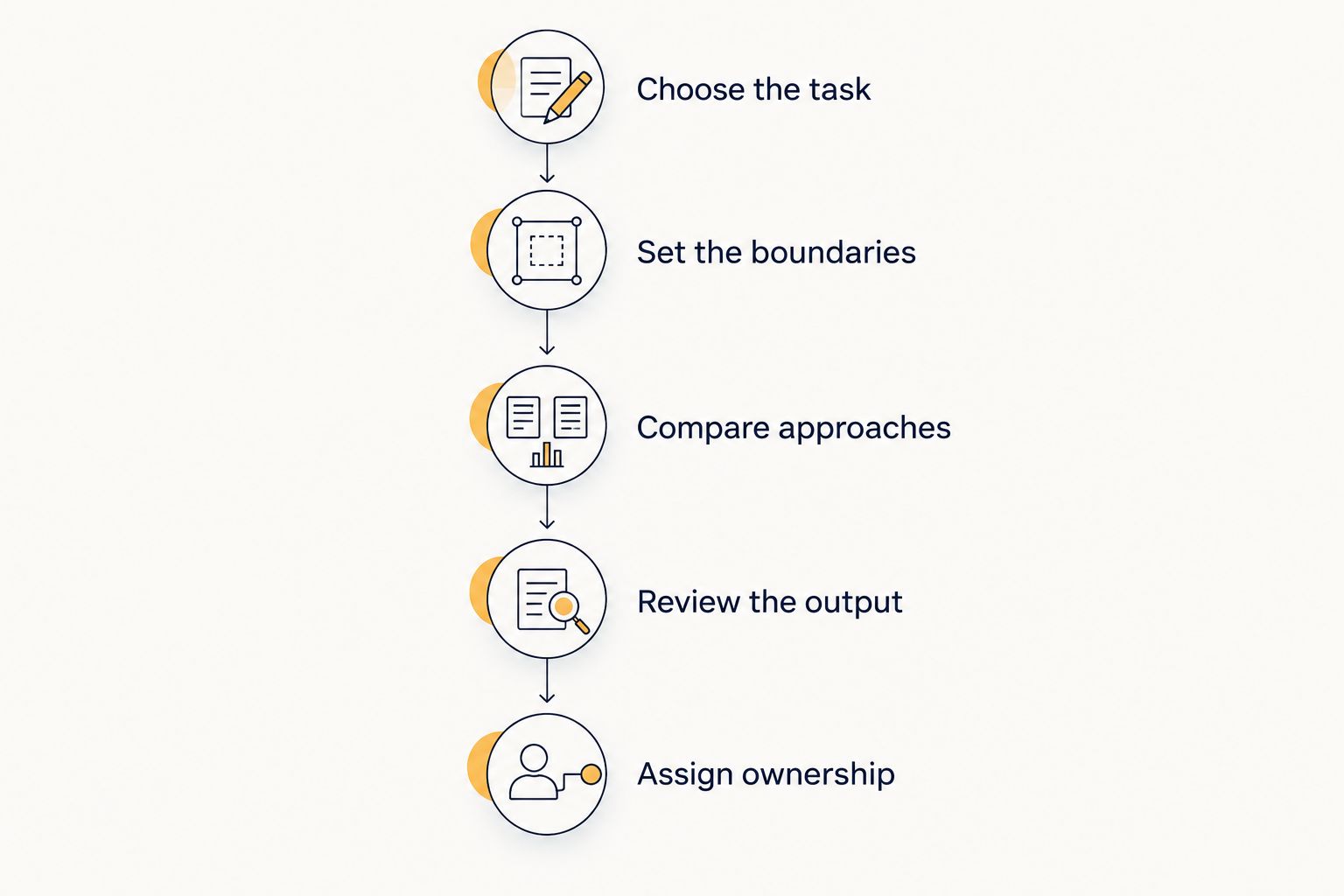
Use a task-based evaluation in 2026. Take one real, approved example through the whole process, including the point where a seller checks the result.
- Choose the task. Select a specific job, such as preparing a proposed CRM update after a discovery call. Avoid a brief as broad as improving sales productivity.
- Set the boundaries. Identify approved inputs, permitted actions and the information the system must never assume. Decide who reviews the output.
- Compare approaches. Ask whether existing software supports the job, whether a tailored implementation is required or whether seller instruction is the immediate need.
- Review the output. Check factual accuracy, missing details, record selection and corrections. Inspect the review work as well as the generated result.
- Assign ownership. Decide who handles exceptions and changes before expanding the workflow to other sellers or tasks.
The decision should follow the evidence from that exercise. If sellers cannot agree what a correct CRM update contains, settle that question before asking a provider to automate it.
For a qualified discovery call, bring the current process, an approved example and the problem you need to resolve. Include the seller who performs the work and whoever owns the CRM rules. That gives the conversation a concrete starting point.
Discuss your sales workflow
Bring a CRM update, meeting preparation or follow-up task to a discovery call.
Can AI sales agents update the CRM without seller approval?
CRM updates without seller approval should be an explicit workflow decision, not a default assumption. Verify the tool's supported actions and permissions, then define which changes require review.
Start your evaluation with proposed updates. Check how the system treats missing next steps, conflicting notes and an opportunity that has been matched to the wrong record. Require an exception path rather than accepting a plausible-looking entry.
Should you train sellers before building custom agents?
Train sellers first when the immediate problem is unclear instructions or weak output review. Choose implementation when the task is already defined and the barrier is carrying it out across systems.
You can also scope both together. Keep the outcomes distinct: a workshop should address seller capability, while an agent implementation should address a defined operational workflow.
Can AI sales agents handle forecasting?
Define the forecasting task before choosing an agent. Preparing a summary of opportunity records is different from recommending a forecast judgement or changing a forecast category.
Ask the provider to show which source fields support each output and how unsupported conclusions are handled. Keep accountability for forecast decisions explicit, regardless of whether the supporting work is custom-built or ready-made.
FAQ
What's the best choice: custom AI sales agents or ready-made tools?
Choose custom AI sales agents when a defined workflow requires behaviour that ready-made tools cannot support. Choose an existing tool when its demonstrated features meet your requirements without critical workarounds.
Do we need a custom AI agent just to draft sales follow-ups?
A follow-up drafting task does not automatically require a custom agent. Test whether an approved assistant or existing tool can produce a useful draft from your source notes, with seller review before sending.
Is a sales-specific AI workshop better than general AI training?
A sales-specific workshop is the closer fit when your goal is practical work on meeting preparation, CRM notes and follow-ups. General training fits a broader learning goal; inspect the syllabus rather than assuming it covers sales workflows.
Can our sellers use Claude without building a custom agent?
Sellers can use Claude for user-directed drafting and analysis without commissioning a custom agent. Use approved information, give clear instructions and review the result; connecting systems or automating actions is a separate requirement.
What should we ask an AI sales agent provider to demonstrate?
Ask the provider to demonstrate your actual task using approved example material. Inspect source handling, proposed actions, approval controls and the response to missing or conflicting information.
What does Onwise offer sales teams?
Onwise offers custom AI sales agents and hands-on AI sales workshops for B2B sales teams in ANZ. Compare those services against whether you need tailored implementation, practical seller training or both.
What should we bring to an AI sales discovery call?
Bring a defined sales-admin task, its current process and an approved example of the input and expected output. Include the relevant seller and process owner so the discussion covers both daily use and operational requirements.
One last thing
A useful 2026 evaluation includes an example where the correct response is to stop. Remove a buyer's next step from the source notes, or provide conflicting account information, and inspect what happens.
The output you want is not a confident guess. It is a clear request for the missing information or a referral to the person responsible. Test the boundary, not just the successful example.