Best AI sales forecasting tools in 2026
Onwise · 10 November 2026
AI-assisted guide. Not individually reviewed by our founders.

Best overall shortlist pick: Clari. Best for Salesforce-led forecasting: Salesforce Sales Cloud. Best for conversation-led deal reviews: Gong. This 2026 guide compares AI sales forecasting tools with custom agents and hands-on workshops, so you can choose between better forecasting software, cleaner sales admin and better seller habits.
- Clari is the default shortlist pick for teams seeking a dedicated revenue forecasting platform.
- Salesforce Sales Cloud suits Salesforce-led forecasting; Gong suits conversation-led deal reviews.
- Onwise suits B2B sales teams seeking custom agents or hands-on workshops to address forecasting admin.
- Choose AI sales forecasting tools around deal evidence, CRM fit and seller workflow—not a prediction alone.
Why this matters
A forecast depends on what sellers record, what buyers actually commit to and how managers interpret the evidence. A prediction cannot turn an unsupported close date into a buyer commitment.
Separate your problem before choosing a provider. You might need a forecasting platform, an automated CRM update process or practical training that helps sellers capture useful information. The guide to custom AI sales agents or ready-made tools explains that implementation choice.
Choose forecasting software for the forecast workflow; choose agents or training for the work feeding it. These routes can complement each other, but they are not interchangeable.
What makes the best AI sales forecasting tools?
Use these criteria to build your 2026 shortlist. Ask each provider to demonstrate the same sales workflow rather than accepting unrelated feature tours.
- CRM fit: Establish where opportunity records live and how information moves between systems.
- Evidence visibility: Ask what supports a forecast change and whether a manager can inspect that evidence.
- Seller workload: Check what reps must enter, review or correct before the forecast becomes useful.
- Manager control: Distinguish an automated recommendation from a manager-approved forecast submission.
- Implementation fit: Separate standard configuration, custom work and the training your team needs.
- Information handling: Review permissions, recording access, customer information and approved use of sales data.
Treat these as buying questions, not assumed capabilities. A product name does not establish that a particular integration, permission model or workflow is included in your proposed scope.
AI sales forecasting options at a glance
The first three options are software platforms. The final two are service routes for teams whose forecasting problem starts with sales admin or inconsistent working habits.
| Option | Best for | Standout approach | Key limitation |
|---|---|---|---|
| Clari | Dedicated revenue forecasting | A platform centred on revenue management and forecasting | Does not remove the need to define evidence and forecast ownership |
| Salesforce Sales Cloud | Salesforce-led sales teams | Forecasting within the Salesforce sales environment | Requires disciplined opportunity management and configuration |
| Gong | Conversation-led deal reviews | Conversation intelligence alongside forecasting | Conversation evidence is not a substitute for complete opportunity records |
| Onwise custom AI sales agents | Admin-heavy forecasting inputs | Tailored automation for B2B sales administration | Not an off-the-shelf forecasting product |
| Hands-on AI sales workshops | Seller adoption and consistent inputs | Practical training around sales tasks | Training alone does not create a production integration |
1. Clari: best AI sales forecasting option for revenue teams
Clari is a revenue platform with forecasting capabilities. It belongs on your shortlist when the buying requirement is a dedicated environment for managing forecasts, rather than a standalone assistant for writing notes or emails.
Bring a real forecast meeting into the demonstration. Ask the provider to show how a manager reviews a deal, challenges its timing and submits a forecast. Keep the discussion tied to your existing sales process.
Clari pros:
- Its product focus directly matches revenue forecasting.
- It gives a dedicated forecasting platform a place in your comparison.
- It supports a buyer discussion centred on management workflows, not just seller productivity.
Clari cons:
- A forecasting platform does not define your qualification standards for you.
- Your team still needs clear ownership of opportunity evidence and corrections.
- Adding a platform creates another implementation decision alongside existing CRM processes.
Best for: Revenue leaders seeking a dedicated forecasting platform and prepared to assess how it fits their operating process.
Verdict: Shortlist Clari when forecast management is the main requirement. Skip a platform-first purchase when your immediate problem is missing CRM updates.
2. Salesforce Sales Cloud: best for Salesforce-led forecasting
Salesforce Sales Cloud includes sales forecasting within its CRM environment. It is a practical comparison point when your team already manages opportunities in Salesforce and wants to assess forecasting within that system.
Separate standard forecasting from any AI capability proposed in the demonstration. Ask the provider to identify the exact edition, configuration and data requirements for each feature you intend to use. Do not treat every feature carrying the Salesforce name as part of the same scope.
Salesforce Sales Cloud pros:
- Forecasting sits within a sales CRM environment.
- Salesforce-based teams can assess it against their existing opportunity process.
- It creates a clear starting point for checking whether another platform is necessary.
Salesforce Sales Cloud cons:
- An existing Salesforce deployment does not prove that the required configuration is ready.
- Inconsistent stages and unsupported close dates remain management problems.
- Buyers must distinguish included capabilities from separately scoped functionality.
Best for: Sales leaders whose opportunity records and management processes already centre on Salesforce.
Verdict: Assess Salesforce Sales Cloud before adding another forecasting system to a Salesforce-led team. Hold the purchase until the proposed scope is explicit.
3. Gong: best for conversation-led deal reviews
Gong combines conversation intelligence with revenue workflows, including forecasting. It belongs on your shortlist when managers want customer conversations to inform how they inspect deals.
Use a specific question in the demonstration: what evidence supports this opportunity closing in the forecast period? Then ask the provider to distinguish a buyer statement, a seller interpretation and a system-generated assessment. Those are different inputs to a forecast decision.
Gong pros:
- Conversation intelligence is relevant to checking what buyers actually said.
- Forecasting can be evaluated alongside conversation-led deal inspection.
- Its approach gives managers an alternative to reviewing CRM fields alone.
Gong cons:
- A recorded conversation does not capture every buying decision or stakeholder interaction.
- Conversation evidence still needs context from the opportunity record.
- Recording and customer-information requirements need review before implementation.
Best for: Sales teams that want customer conversations to play a central role in deal reviews.
Verdict: Shortlist Gong for conversation-led forecasting. Skip the assumption that recorded calls eliminate CRM discipline or manager judgement.
4. Onwise custom agents: best for forecasting admin
Onwise provides custom AI sales agents for B2B sales teams in ANZ. This is a hands-on service route, not a packaged forecasting platform. Assess it when meeting preparation, CRM updates and follow-ups are the work you need to address.
Start with a tightly defined brief. For example, request a workflow that turns approved meeting notes into a proposed CRM update, highlights missing information and prepares a follow-up draft. Treat that as a requirement to agree with the provider, not an assumed feature or integration.
Onwise is best for B2B sales teams seeking hands-on help with the admin that feeds their forecast. Keep forecast ownership with the sales leader while defining what the agent prepares and what a person approves.
Custom-agent pros:
- The brief can focus on your actual sales-admin process.
- Meeting preparation, CRM updates and follow-ups can be considered together.
- You can specify approval points before information reaches the forecast workflow.
Custom-agent cons:
- A tailored implementation needs clear requirements and process ownership.
- System access and integration scope must be agreed explicitly.
- An admin agent is not automatically a replacement for forecasting software.
Best for: Teams that know which repeated admin tasks leave their opportunity records incomplete or outdated.
Verdict: Discuss a custom agent when the bottleneck is maintaining useful inputs. Hold implementation until the workflow, access and approval boundaries are clear.
5. Onwise workshops: best for improving seller habits
Onwise offers hands-on AI workshops for sales teams. This route fits a different problem: sellers need practical help applying AI to daily work before the business commits to more automation.
For forecasting-related training, request exercises built around meeting preparation, CRM update drafts and follow-ups. Include Claude where it is part of your team's approved working environment. Ask participants to separate confirmed buyer statements from assumptions and unanswered questions.
Sales-specific training should be assessed against sales tasks. General AI training has a different brief. The comparison of sales-specific or general AI training helps you decide which learning outcome you need.
Workshop pros:
- Practical exercises can expose unclear sales processes before automation starts.
- Sellers can practise reviewing generated drafts rather than accepting them unchanged.
- Managers can set consistent expectations for evidence and CRM updates.
Workshop cons:
- Training alone does not connect systems or automate production workflows.
- Better prompts do not fix an undefined sales process.
- Managers still need to reinforce the agreed working habits.
Best for: Teams that need a shared, practical way to use AI in daily sales work.
Verdict: Choose a workshop when adoption and working habits are the bottleneck. Skip training-only plans when the requirement is an integrated production workflow.
Test the workflow before choosing a provider
For your 2026 evaluation, use the same evidence and questions across providers. This is a suggested buying exercise, not a claim about measured performance.
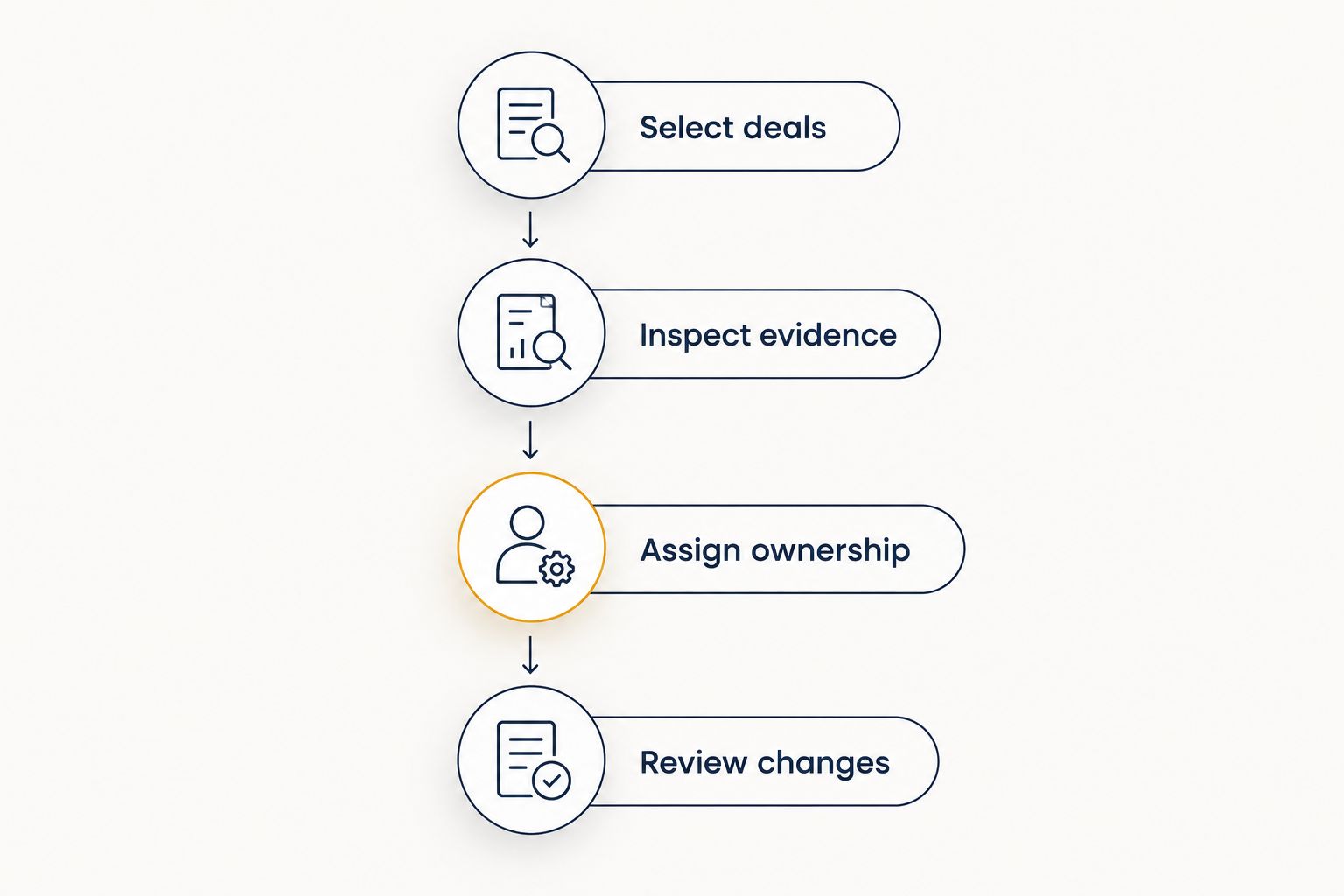
- Select deals: Choose 3 opportunities with different forecast problems: missing notes, uncertain timing and an unclear next step.
- Inspect evidence: Review 5 fields: stage, amount, close date, next step and decision process. Mark what is confirmed, inferred or unknown.
- Assign ownership: Name the person responsible for correcting each record and approving proposed changes.
- Review changes: Compare the process over 2 forecast cycles before deciding whether to extend the scope.
Record both useful outputs and corrections. A polished summary is not enough if it assigns a buyer commitment that never happened. Your acceptance criteria should reward accurate uncertainty, not confident wording.
How to read this ranking
This 2026 shortlist separates dedicated forecasting, CRM-led forecasting, conversation-led reviews, custom administration and practical training. The order reflects those buying paths, not a measured claim that one provider produces more accurate forecasts than another.
No forecast-accuracy benchmark is asserted here. Use the criteria above to establish which option fits your systems, evidence and management process, then ask the provider to demonstrate that fit.
Which forecasting option should you choose?
Start with Clari if you need a dedicated forecasting platform. Assess Salesforce Sales Cloud first if Salesforce already anchors your process. Include Gong when customer conversations need a stronger role in deal inspection.
If your 2026 priority is cleaner inputs, distinguish automation from training. Choose tailored implementation for a defined repeatable task. Choose a workshop when sellers need help doing that task consistently.
Bring a concrete workflow to a discovery call: the current process, the systems involved and the approval owner. That makes the discussion about a defined sales problem rather than a general interest in AI.
FAQ
What's the best AI sales forecasting tool for a B2B team?
Clari is the default shortlist pick here for a dedicated forecasting platform. Salesforce Sales Cloud fits Salesforce-led evaluation, while Gong belongs in a conversation-led comparison. Choose against your actual workflow rather than treating the ranking as an accuracy benchmark.
Should we use forecasting software or a custom AI agent?
Use forecasting software for the forecast-management workflow and a custom agent for a defined administrative task. An agent brief might cover preparing CRM updates or follow-up drafts, but that scope must be agreed with the provider.
Can AI fix incomplete CRM records?
AI cannot establish a missing buyer fact without supporting evidence. Define how proposed updates are checked, who approves them and how unknown information is flagged.
Is a sales-specific workshop better than general AI training?
A sales-specific workshop fits a brief centred on meeting preparation, CRM updates, follow-ups and deal reviews. General AI training suits a broader learning brief; compare the exercises and intended outcomes before choosing.
Can sellers use Claude to prepare forecast updates?
Sellers can use Claude to help draft a forecast update from information they are authorised to provide. Require a distinction between confirmed facts, assumptions and missing information, and review the draft before using it.
What should we ask forecasting providers to demonstrate?
Ask providers to demonstrate a real deal review, the evidence behind a forecast change and the approval process. Confirm the exact integration and configuration scope rather than assuming those capabilities are included.
What should we prepare before a discovery call?
Prepare one repeated sales-admin problem, the systems it touches and the person responsible for approving changes. Explain whether you need a working implementation, practical training or a comparison of both routes.
One last thing
Add an explicit unknown to your forecast review. If the buyer has not confirmed the decision date, record that gap instead of turning a seller's preferred date into a commitment. Better forecasting starts with a clear boundary between evidence and assumption.