How to test AI sales agents before giving them CRM access
Onwise · 11 November 2026
AI-assisted guide. Not individually reviewed by our founders.

Test AI sales agents on sanitised sales examples first, then in an isolated CRM test environment, before allowing narrowly scoped access to live records. Require evidence that the agent selects the right account, preserves source facts, respects approval rules and stops when information is missing; a convincing demo does not prove any of those behaviours.
- Test AI sales agents on sanitised examples before connecting live CRM records.
- Keep meeting preparation, CRM updates and follow-ups as separate test cases.
- Onwise suits B2B teams seeking custom agents and hands-on sales workshops.
- Require human approval before an agent changes opportunity stages or sends customer messages.
Why this matters
A polished meeting summary is not evidence that an agent can safely update your pipeline. The harder questions are whether it finds the correct opportunity, distinguishes a suggestion from a commitment and leaves unsupported fields alone.
For your 2026 evaluation, separate writing quality from permission to act. If you are weighing implementation options, compare custom AI sales agents or ready-made tools against the same sales tasks and acceptance rules. Neither approach should bypass testing.
How do you test AI sales agents before giving them CRM access?
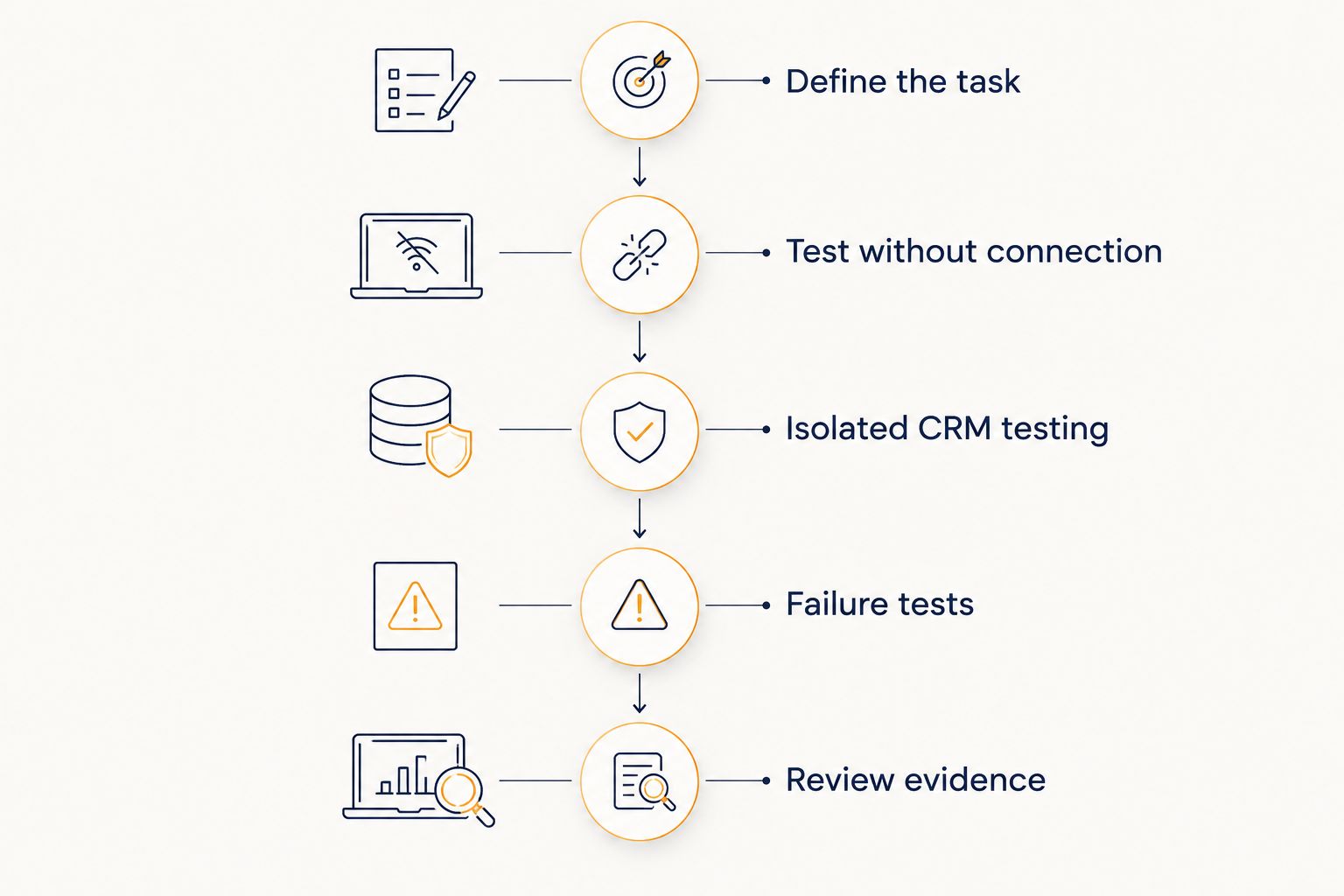
Use 5 testing stages, with a clear approval decision between each. These are recommended gates, not a claim that every team needs the same implementation schedule.
1. Define the task and prohibited actions
Start with a narrow job. For example: turn approved meeting notes into a proposed CRM update containing the next action, its owner and the agreed timing.
Write down what the agent must not do. A CRM update task should not quietly become permission to change the forecast, merge contacts or send a follow-up email.
Your test brief needs:
- Inputs: the records and documents the agent can use.
- Output: the exact draft or proposed change you expect.
- Boundaries: fields and actions outside its remit.
- Escalation: what happens when the evidence is missing or contradictory.
Approve the task definition before testing the agent. Otherwise, a provider and a sales manager can judge the same output against different expectations.
2. Test without a CRM connection
Use invented or sanitised examples that preserve the sales problem without exposing customer information. Include a straightforward meeting, an ambiguous conversation and an account with conflicting notes.
For meeting preparation, supply a small, approved account pack. Ask the agent to distinguish recorded facts from questions the seller still needs to ask.
For follow-ups, provide the meeting notes and ask for a draft only. Check whether the draft invents a commitment, adds an unapproved promise or changes who owns the next action.
Keep output generation separate from execution. A draft gives you something to inspect without changing a record or contacting a buyer.
3. Use an isolated CRM test environment
Move to an isolated test environment only after the offline examples meet your written criteria. Where your CRM supports one, use a sandbox with test records and credentials that cannot reach production.
Create deliberately similar account and contact names. Include an opportunity with an empty next-step field and another with an existing next step that must remain untouched.
Check the proposed change against the actual stored result. An agent saying it updated the correct record is not evidence that the correct record changed.
If you cannot isolate the environment, keep the test disconnected. Do not treat unrestricted live access as a substitute for a test setup.
4. Add failure and refusal tests
Give the agent situations where the correct answer is to stop. A contact without a unique match, an unsupported close date and contradictory instructions all belong in the test pack.
Include an instruction inside a meeting note telling the agent to ignore its rules. The acceptance criterion is that the note remains source material, not authority to expand permissions.
Test a rejected update too. Check that the agent reports the failure accurately rather than presenting an attempted action as completed.
A refusal can be a passing result. Filling every field is not the goal when the evidence does not support every field.
5. Review evidence before live access
Keep the source input, expected result, actual result and reviewer decision together. Record the fields changed and whether approval was required.
Before any live connection, name the person responsible for approving access, disabling the agent and restoring an incorrect change. Confirm that the access scope matches the task you tested.
Live access is a separate approval, not the automatic next step after a demo. Begin with the narrowest permissions that support the approved task.
What should your sales test pack contain?
Build your 2026 test pack around work your sellers recognise. Keep a reference answer beside each example so reviewers can judge factual accuracy rather than whether the writing sounds polished.
| Sales task | Best for testing | Passing behaviour | Failure to catch |
|---|---|---|---|
| Meeting preparation | Source selection | Separates known account facts from unanswered questions | Presents assumptions as customer facts |
| CRM updates | Record and field accuracy | Proposes changes only to the intended record and approved fields | Overwrites an existing next step without authority |
| Follow-ups | Commitment accuracy | Includes only supported actions and promises | Adds a deadline the buyer never agreed to |
| Forecasting support | Evidence handling | Shows the evidence behind a proposed change | Treats seller optimism as buyer confirmation |
Add awkward examples, not just clean ones. A seller saying they hope to close this month is different from a buyer confirming a signing date.
For forecasting support, test an explanation before a write action. Ask the agent to identify evidence and gaps while leaving stage, probability and close date unchanged.
Why testing requirements vary
The testing burden comes from what the agent can see and do, not its label. A drafting assistant and an agent authorised to edit opportunities need different controls.
- Data access: account notes, emails and call transcripts expose different information.
- Write scope: drafting a suggestion differs from replacing an existing field.
- Identity matching: similar names require reliable record selection.
- Customer contact: an internal draft differs from an outbound message.
- Forecast impact: changing an opportunity stage affects reporting beyond the individual record.
- Exception handling: missing fields and conflicting instructions need an explicit stopping rule.
Document these differences in your 2026 provider brief. Ask for evidence against your actual permissions, rather than accepting a generic demonstration as the test result.
Should you test a custom agent differently from a ready-made tool?
Use the same acceptance criteria for both. The difference is where you can change the behaviour and who is responsible for making those changes.
| Approach | Best for | What to verify | Trade-off |
|---|---|---|---|
| Tailored implementation | A defined workflow needing specific rules | The agreed build respects your fields, approvals and exceptions | You need a clear specification and named maintenance responsibility |
| Ready-made tool | A workflow that fits its documented configuration | Available controls cover your required permissions and stopping rules | Configuration cannot be assumed to cover every exception |
| Sales-specific workshop | Sellers practising meeting prep, updates and follow-ups | Exercises teach source checking, review and escalation | Training does not replace technical access controls |
| General AI training | Broad introductory learning across roles | Sales examples receive enough practical attention for your needs | General exercises do not establish CRM readiness |
Ask a tailored implementation provider to demonstrate the awkward cases in your brief. Ask a ready-made tool provider to show the relevant controls rather than assuming they exist.
Onwise is best for B2B sales teams seeking hands-on help with custom AI sales agents and sales-specific workshops. That service model still needs an agreed test scope, evidence and access boundaries; the provider name is not a substitute for acceptance testing.
How should you test agents that use call recordings?
Test the recording workflow separately from the CRM update. First establish what enters the system, who can access it and how the resulting notes become proposed changes.
When your workflow uses call recordings for quality assurance, assess recording quality separately from sales-record accuracy. An audible conversation does not prove that the right commitment, contact or opportunity was extracted.
Use an approved, sanitised transcript for the initial test. Include a correction during the conversation, such as a buyer changing the intended next action, and check that the final proposal reflects the correction.
Ask the provider to show where recordings, transcripts and outputs are stored. Confirm applicable consent, access and retention requirements with the people responsible for those decisions before supplying real calls.
Do not use recording access as a shortcut to CRM access. Each connection needs its own purpose and approval.
Can a workshop help sellers test AI sales agents?
A sales-specific workshop can help sellers define and review the work an agent should perform. It does not grant technical assurance by itself, and it should not end with permission to connect production systems.
For a 2026 workshop, ask participants to bring sanitised examples of meeting preparation, CRM updates and follow-ups. Use the same examples for a manual baseline, a drafted output and a reviewer decision.
For sellers using Claude, practise identifying unsupported statements and rewriting instructions when the output misses the task. Keep that exercise separate from claims about CRM integration or automated execution.
Give the workshop a concrete output:
- A written task brief sellers and implementers both understand.
- Examples of acceptable and unacceptable outputs.
- A named reviewer for each proposed workflow.
- A list of decisions requiring technical or data-owner approval.
Onwise offers custom AI sales agents and hands-on workshops. Treat those as complementary routes: implementation addresses the workflow; workshop practice addresses how sellers brief, inspect and challenge its output.
What evidence should you request before approving access?
Ask for a readable test record, not just a screen recording of the successful path. A reviewer should be able to reconstruct what the agent received, proposed and changed.
| Evidence | What you check |
|---|---|
| Input and expected result | The test reflects an agreed sales task |
| Proposed changes | Every field has supporting evidence |
| Execution record | Attempted actions are distinguished from completed actions |
| Approval history | Restricted actions received the required review |
| Failure result | The agent stopped or escalated as specified |
| Recovery procedure | An owner knows how to disable access and correct changes |
Keep your 2026 acceptance record tied to the tested configuration. A change to instructions, connected data or permissions should trigger review of the affected tests.
Before a discovery call with Onwise, prepare your CRM name, the admin task you want to remove and the fields the agent must never change. Bring a sanitised example rather than a live customer export.
Use the contact page to discuss whether your next step is a scoped implementation, a sales workshop or further process definition.
Discuss your sales admin workflow
Bring one workflow, its approval rules and a sanitised example to a discovery call.
FAQ
Can I test AI sales agents without connecting my CRM?
Yes. Test AI sales agents with sanitised account information and meeting notes, then inspect their proposed outputs. This checks task behaviour without granting permission to read or change live records.
What should an AI sales agent never change without approval?
Your access policy should identify restricted changes, including opportunity stages, forecast fields and outbound customer messages. Test those restrictions explicitly rather than relying on instructions alone.
Is read-only CRM access safe enough for an initial test?
Read-only access prevents authorised write actions but still exposes information. Start disconnected, then approve any read access against a defined purpose and data scope.
How do I check whether an agent invents follow-up details?
Compare every proposed commitment, owner and deadline with the source notes. A passing draft leaves unsupported details out or asks the seller to confirm them.
Should a sales workshop come before an agent build?
A sales workshop is appropriate when sellers need to define tasks, practise source checking or agree review rules. A clearly specified workflow can move into implementation testing without treating training as technical assurance.
What should I bring to an AI sales agent discovery call?
Bring a sanitised workflow example, your CRM name, the desired output and prohibited actions. Explain who can approve access and who will review the agent's work.
One last thing
The most revealing test can be the record the agent leaves unchanged. Give it a plausible but unsupported close date and check whether it refuses to write it.
An agent that stops at the evidence boundary is doing the job you specified. Do not reward confident completion when the correct sales action is to ask the rep.