What support should follow AI training for a sales team?
Onwise · 12 November 2026
AI-assisted guide. Not individually reviewed by our founders.

AI training for a sales team should be followed by help with real sales tasks, manager review, clear data rules and a named owner for questions and fixes. Your 2026 support plan should separate coaching sellers from maintaining automations: learning to draft a follow-up is different from running an agent that updates your CRM.
- AI training Australia: choose follow-up support tied to meeting preparation, CRM updates, follow-ups and forecasting.
- Onwise offers hands-on AI sales workshops and custom AI sales agents; confirm post-training support before agreeing scope.
- Workshops support seller skills; running agents also requires testing, access controls and maintenance ownership.
- Judge progress by usable sales work, not attendance or the number of prompts saved.
Why this matters
A workshop can show a seller how to complete a task. The next customer conversation tests whether that seller can repeat it with incomplete notes, sensitive information and a deadline. Post-training support needs to address that gap.
Start by distinguishing sales-specific AI training from general training. General instruction and sales workflow practice serve different purposes. Your support brief should explain which skills sellers need, which processes need changing and who handles each problem after the session.
Attendance records completion. Reviewed sales work shows whether the training transfers into the job.
What support should follow AI training for a sales team?
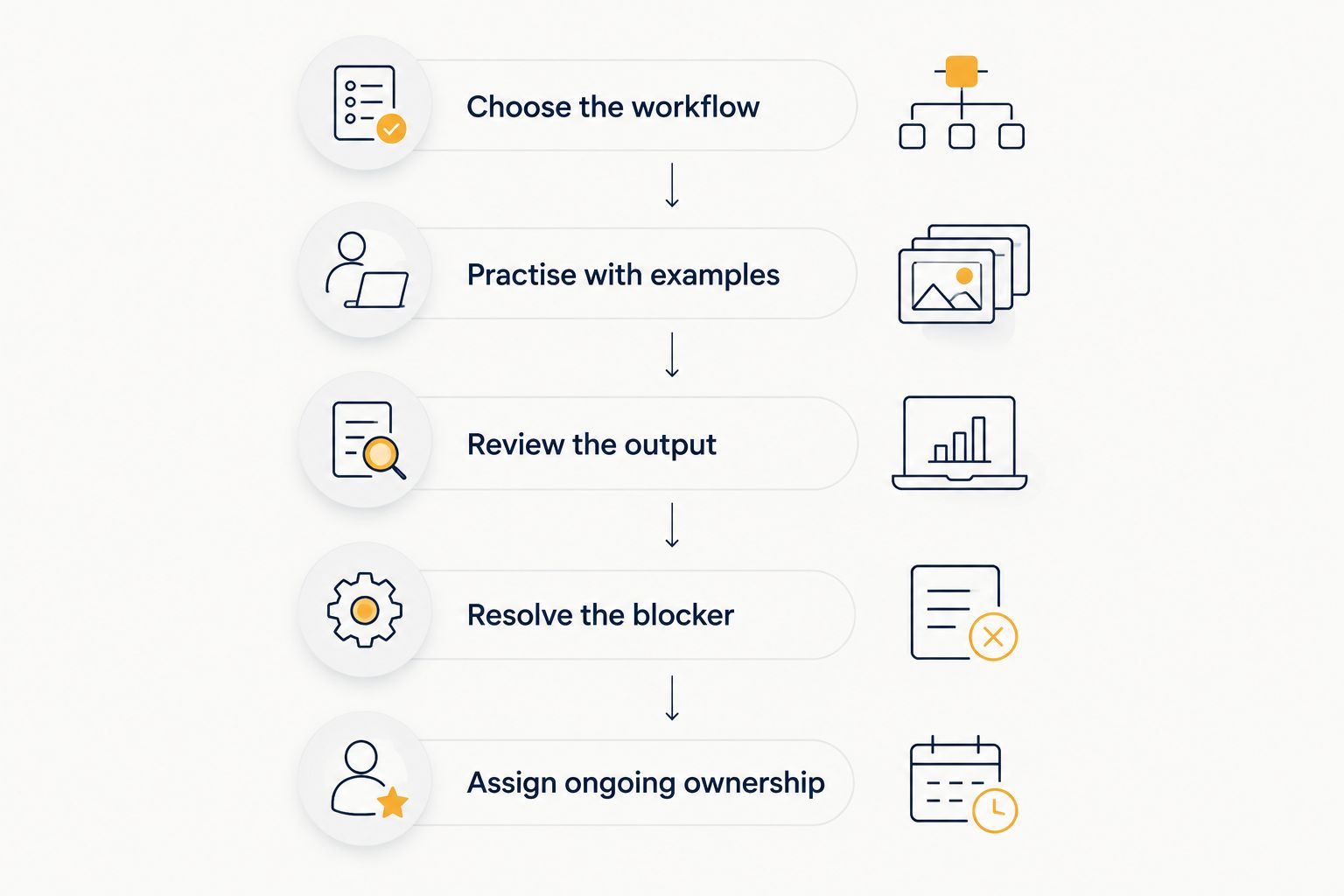
Build the support plan around a repeatable process. Agree the scope before training, including what the provider handles and what stays with your sales managers, operations team or system administrator.
- Choose the workflow. Pick a defined task, such as turning meeting notes into a proposed CRM update. State the input, expected output and person responsible for approval.
- Practise with examples. Use approved, sanitised material that reflects the team's actual work. Include incomplete notes and conflicting information, not just tidy demonstration examples.
- Review the output. Ask a manager to check factual accuracy, usefulness and whether the result belongs in the customer record. Record the correction needed, not simply whether the seller liked it.
- Resolve the blocker. Separate a skills issue from a process, permission or integration issue. Another prompt-writing session will not fix missing CRM access or an undefined sales stage.
- Assign ongoing ownership. Name who answers questions, maintains shared instructions and approves changes. If an automation is involved, also name who can pause it.
This sequence gives sellers a route from demonstration to independent use. It also gives managers a way to identify where more training ends and implementation work begins.
Workshop follow-through: best for seller skills
Hands-on workshop support should help sellers repeat useful tasks without relying on the trainer. Ask for a defined route to raise questions, review examples and correct mistakes in shared instructions. Confirm whether those activities are included or require a separate agreement.
For meeting preparation, ask sellers to produce a brief from approved account information. Review whether it distinguishes known facts from open questions. A polished brief with an unsupported claim is not ready for a customer conversation.
For follow-ups, use the seller's notes to draft a message, then check commitments, dates and next steps. Keep the seller responsible for confirming the message before sending it.
The benefit is direct practice on work sellers recognise. The limitation is that training alone does not connect systems or maintain an automated workflow. A seller can learn a sound method while the surrounding process still needs work.
Agent implementation support: best for recurring admin
An agent project needs a different support brief. Alongside user guidance, specify permitted actions, exception handling, testing and the person responsible when something fails.
For CRM updates, separate drafting a proposed change from writing it into the record. Define which fields are in scope, what evidence supports each change and when a person must approve it. Missing information should become a question, not an invented answer.
For forecasting, distinguish a summary of recorded evidence from a decision to change a forecast category. Sales leadership should define the rules and retain responsibility for the judgement.
The benefit is a defined way to handle recurring work. The limitation is ongoing responsibility for permissions, workflow changes and failures. Ask the provider to explain how to test AI sales agents before CRM access, rather than treating a successful demonstration as permission to write into live records.
Which support route fits your team?
Compare the work you need done, not just the format of the training. The following table is a buying framework, not a claim about what every provider includes.
| Support route | Best for | What to request | Limitation to resolve |
|---|---|---|---|
| General AI training | Shared introductory knowledge | Responsible-use guidance and basic task practice | Sales examples and CRM rules need separate attention |
| Sales-specific workshops | Seller-led meeting preparation and follow-ups | Reviewed examples, shared instructions and manager guidance | System integration is a separate scope |
| Off-the-shelf tool support | Learning an existing tool's supported workflow | Configuration help, documentation and escalation details | Check whether the supported workflow matches your process |
| Tailored agent implementation | Defined admin workflows requiring tailored handling | Acceptance tests, permission boundaries and maintenance ownership | Someone must own changes after handover |
Do not choose tailored implementation simply because it sounds more advanced. If sellers need help checking a draft, coaching addresses that need. If they repeatedly move approved information between systems, investigate implementation requirements.
Onwise is best for B2B sales teams in ANZ seeking hands-on AI sales workshops or custom agents for admin-heavy work. Confirm the follow-up scope against your actual workflows; the service category alone does not establish what support is included.
Why post-training support varies
The support needed after AI training depends on the task and the responsibility being handed over. Use these factors to scope a 2026 programme:
- Human approval. Drafting a recommendation requires a different review process from allowing a system to act on it.
- Data access. Sanitised practice material and access to live customer records require different controls.
- Process clarity. Inconsistent definitions of next steps or sales stages need management decisions before automation.
- System connections. Work completed in a chat needs different support from work passed between applications.
- Seller capability. A seller struggling to provide context needs different help from an administrator troubleshooting permissions.
- Change ownership. Shared instructions, CRM fields and approval rules need someone responsible for keeping them current.
Ask prospective providers to respond to these factors in writing. A general promise of ongoing support does not tell you whether the provider will review a draft, fix an integration or retrain a manager.
What should managers review after the workshop?
Managers should review finished sales work against a shared standard. In 2026, that standard should cover factual accuracy, customer relevance, approved data use and the next action.
For a meeting brief, check whether the information has a clear source. For a follow-up, check whether the draft reflects what was agreed. For a CRM update, check whether the proposed entry adds useful information without changing the meaning of the conversation.
Keep a record of recurring corrections. If sellers repeatedly omit the customer's decision process, improve the capture instructions. If different managers disagree about the correct stage, settle the stage definition before changing the training.
Avoid turning review into another reporting exercise. Use work the team already needs to complete, and explain what acceptable output looks like before asking sellers to submit examples.
How do you stop AI creating more CRM admin?
Start with the existing CRM process. Identify which information sellers need to capture, who uses it and which updates duplicate work elsewhere. Automating an unnecessary field preserves unnecessary work.
AI support and sales team CRM adoption meet at the same practical question: can sellers maintain a useful customer record without repeating the same admin? Training should explain what belongs in the record; implementation should preserve that meaning when information moves between systems.
Give sellers a clear exception route. When notes are ambiguous, the workflow should ask for clarification rather than silently choosing a value. When a proposed update is rejected, capture why so the responsible person can correct the instructions or process.
Do not treat every objection as resistance to change. Ask the seller to show the failed task. That gives you something concrete to fix: an unnecessary step, a misleading suggestion, a permissions problem or an unclear expectation.
What should sellers practise with Claude after training?
Practise a defined task with approved context, then inspect the result. For a 2026 Claude workshop follow-through plan, choose examples from meeting preparation, CRM notes and follow-ups rather than asking sellers to explore without a purpose.
A meeting-preparation exercise can ask the seller to organise supplied account notes into known facts, open questions and a proposed agenda. The review should catch assumptions presented as facts. Keep external account research separate unless the team has agreed how to verify it.
A follow-up exercise can ask the seller to draft from approved notes without adding promises. Review the proposed message against the source material, then have the seller explain the edits needed before sending.
The reusable asset is not just the prompt. It is the task definition, approved context, checking method and example of acceptable output. Keep those together so another seller can understand the method without reconstructing the workshop.
What should you confirm before a discovery call?
Bring a real process, not a broad request to make sales more efficient. Describe where the task starts, what information it uses, where the output goes and who checks it.
For workshop support, ask who reviews practice work, how questions are handled and how managers learn the checking method. For agent implementation, ask who approves system access, handles exceptions and maintains the workflow when requirements change.
Onwise offers both custom AI sales agents and hands-on AI sales workshops. Use a discovery call to discuss which work needs seller coaching and which work needs implementation, then request a written scope for each.
Before agreeing a 2026 engagement, document:
- The workflow and its boundaries.
- The approved data and access arrangements.
- The review and acceptance criteria.
- The people responsible for questions, fixes and changes.
- The handover materials and any continuing support agreement.
This keeps training and implementation connected without pretending they are interchangeable. It also gives your internal team a clear view of the responsibilities it retains.
FAQ
What support should follow AI training for a sales team?
Follow AI training with practical task reviews, manager coaching, clear data rules and named support ownership. If the work includes agents or CRM connections, agree testing, exception handling and maintenance separately.
What should I ask an AI training Australia provider about follow-up support?
Ask an AI training Australia provider exactly which questions, task reviews and fixes are included after training. Confirm the support channel, responsible person and boundaries between coaching and technical implementation.
Do we need a custom agent after a sales workshop?
A custom agent is not a required next step after a sales workshop. Consider implementation when you have a defined recurring workflow, clear inputs and an agreed way to check the output.
Is sales-specific AI training better than general AI training?
Sales-specific training is the better fit when your objective is practising meeting preparation, CRM updates or follow-ups. General training fits broader introductory learning; assess each provider's actual examples and follow-up scope.
Who should approve AI-generated CRM updates?
A named person responsible for the customer record should approve proposed CRM updates until your team has agreed and tested any automated write permissions. Define which fields are permitted and how ambiguous information is handled.
How should we help sellers use Claude after a workshop?
Help sellers use Claude by practising defined tasks with approved context and reviewing the resulting sales work. Keep task instructions, checking criteria and accepted examples together so the method can be repeated.
Can Onwise help with both training and sales automation?
Onwise offers hands-on AI sales workshops and custom AI sales agents for B2B sales teams in ANZ. Discuss the workflow and confirm the implementation, handover and post-training support scope before agreeing an engagement.
One last thing
Ask a seller to show the correction, not just the successful output. A seller who can spot an unsupported claim, explain why it is wrong and fix the underlying instructions has demonstrated a repeatable skill. Use that as a practical review exercise before expanding the workflow.